Revenue Systems Diagnostic Methodology
A practical framework for examining how acquisition, conversion, response, booking, CRM, follow-up, attribution, reactivation, and reporting work together—without treating public signals as proof of internal performance or financial loss.
A revenue systems diagnostic maps the revenue path, tests what can be observed, identifies where evidence or handoffs break, and separates three different statements: what was observed, what that observation may indicate, and what internal evidence would be required to verify the finding. Public signals can reveal visible friction and missing evidence. They cannot prove internal workflow behavior, lead loss, conversion impact, or revenue impact on their own.
What is a revenue systems diagnostic?
A revenue systems diagnostic is an evidence-led review of the connected systems, data, rules, handoffs, and operating controls that move a prospect from first contact to a recorded outcome.
It is not synonymous with a website audit, CRM audit, analytics audit, or automation audit. Each can be one diagnostic surface. The wider diagnostic asks whether those surfaces work together and whether an operator can reconstruct what happened at every transition.
The unit of analysis is not a tool. It is a revenue-path transition: source to destination, visitor to captured intent, captured intent to accountable owner, owner to next action, booking to lifecycle state, and activity to a recorded outcome. A transition is diagnostically healthy when its input, rule, output, owner, timestamp, and exception path can be established with evidence. It is not healthy merely because a tool is installed.
The method is horizontal. The same evidence discipline can be used for a service business, software company, multi-location operator, professional practice, or any organization with a measurable path from inquiry to customer. The systems and cycle times change; the distinction between observation and proof does not.
What the diagnostic examines
A useful diagnostic reviews four connected layers and pays special attention where responsibility passes from one layer to another.
Can a real prospect understand and complete the intended next step?
Pages, forms, phone paths, booking, confirmation, accessibility, mobile behavior.Does each event produce the expected routing, task, message, or state change?
Rules, executions, queue states, timestamps, and fallbacks.Can source, identity, activity, stage, and outcome be connected without silent gaps?
CRM records, event schemas, identifiers, lifecycle definitions, attribution fields.Can an operator see exceptions and recover them before they become stale?
Alerts, reconciliations, ownership views, error queues, operating controls.What public signals can establish
Public evidence is evidence obtainable without account credentials, private report locators, customer records, or privileged system access. It can establish that a public route returned a status at a recorded time; a form, phone number, or booking path was present; a field, consent statement, error, or confirmation state was visible; a redirect or canonical behaved in a specific way; or a permissioned synthetic interaction produced a particular public response.
Each observation should retain the URL or surface, UTC timestamp, device or viewport where relevant, test action, observed result, and sanitized evidence reference. A conclusion without that trace is a suggestion, not a finding.
What public signals cannot establish
Public evidence alone cannot show that a submission created the correct CRM record, an owner accepted an assignment, a missed call became a recoverable task, a workflow enrolled every eligible record, source data survived to an outcome, a dashboard reconciles to the system of record, or an apparent issue affected leads, conversion, or revenue. A compensating internal control may also be invisible from outside.
Observed: The public contact path displayed a success state without a visible reference or next-step expectation.
May indicate: The visitor may have insufficient confirmation or recovery information.
Requires internal verification: Event logs, CRM creation or update history, notification delivery, ownership, and time to first activity.
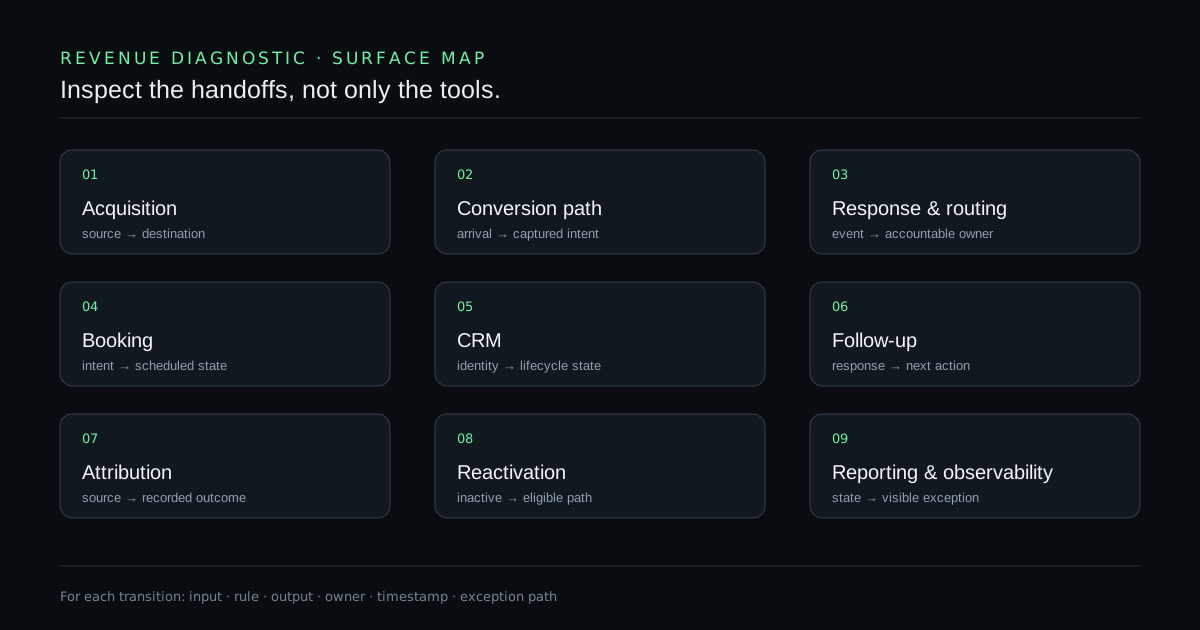
Nine surfaces, one connected revenue path
Each surface has a public evidence ceiling. The diagnostic should say where that ceiling sits before it recommends internal access or a build.
Acquisition
source → destination- Which source classes create measurable demand?
- Does every important source lead to an intentional destination?
- Are campaign and referral identifiers preserved at entry?
- Do message, audience, and destination agree?
- Public evidence
- Destinations, visible source parameters, message continuity, and obvious dead ends.
- Internal verification
- Spend, source volume, channel quality, downstream performance, and source governance.
Conversion path
arrival → captured intent- Is the primary next step clear?
- Is the path usable across relevant devices and input methods?
- Are required fields proportionate to the immediate decision?
- Can a visitor recover from validation, timeout, or interruption?
- Public evidence
- Visible steps, fields, consent language, errors, confirmation states, and recovery paths.
- Internal verification
- Completion rates, field-level abandonment, lead quality, and downstream outcome.
Response and routing
event → accountable owner- What event starts the response clock?
- Which fields determine assignment?
- Does every rule combination have an owner or monitored fallback?
- What happens after hours or when an owner is unavailable?
- Public evidence
- Visible response expectations and permissioned public interaction results.
- Internal verification
- Enrollment criteria, execution history, assignment, notification delivery, and first-activity timestamps.
Booking
intent → scheduled state- Can the intended visitor reach the correct event type?
- Are timezone, availability, duration, and qualification coherent?
- Are cancellation, rescheduling, and no-show states defined?
- Does the referring source remain attributable?
- Public evidence
- Reachability, visible scheduling behavior, confirmations, and public recovery choices.
- Internal verification
- Calendar rules, CRM writes, reminder delivery, attendance, and opportunity-state changes.
CRM
identity → lifecycle state- What is the system of record for each commercial object?
- Which identifiers prevent unintended duplicates or overwrites?
- Do stages have observable entry and exit criteria?
- Are inactive owners, stale records, and invalid values detectable?
- Public evidence
- Almost none beyond visible intake fields and declared integrations.
- Internal verification
- Record history, identity rules, lifecycle definitions, ownership, validation, and data-quality samples.
Follow-up
response → next action- What qualifies a record for human, automated, or mixed follow-up?
- What stops a sequence?
- Do replies, bookings, disqualification, and consent changes suppress correctly?
- Can operators see records with no next action?
- Public evidence
- Visible expectation-setting and messages from permissioned tests.
- Internal verification
- Eligibility, enrollments, exclusions, tasks, delivery, replies, stop conditions, and failure handling.
Attribution
source → recorded outcome- Which source dimensions persist at each commercial stage?
- Which identifiers join browser, form, phone, calendar, CRM, and outcome events?
- How are direct, unknown, duplicate, and offline cases handled?
- Can raw counts reconcile to operating totals?
- Public evidence
- Visible campaign parameters, browser requests, consent behavior, and destination continuity.
- Internal verification
- Event schemas, identity joins, transformations, model definitions, reconciliations, and exception rules.
Reactivation
inactive → eligible path- Which states are eligible?
- Which consent and channel restrictions apply?
- What starts eligibility and what stops the program?
- Can reactivated records be separated from new acquisition?
- Public evidence
- Published preference and unsubscribe paths where applicable.
- Internal verification
- Eligibility rules, consent state, suppression, segmentation, ownership, message history, and outcomes.
Reporting and observability
state → visible exception- Can source, capture, assignment, activity, opportunity, and outcome counts reconcile?
- Are definitions, timezones, filters, and refresh windows documented?
- Are failures visible while action is still possible?
- Can an operator reconstruct state and ownership?
- Public evidence
- Published status behavior and public error states only.
- Internal verification
- Exception queues, logs, reconciliations, definitions, alerts, histories, and operating views.
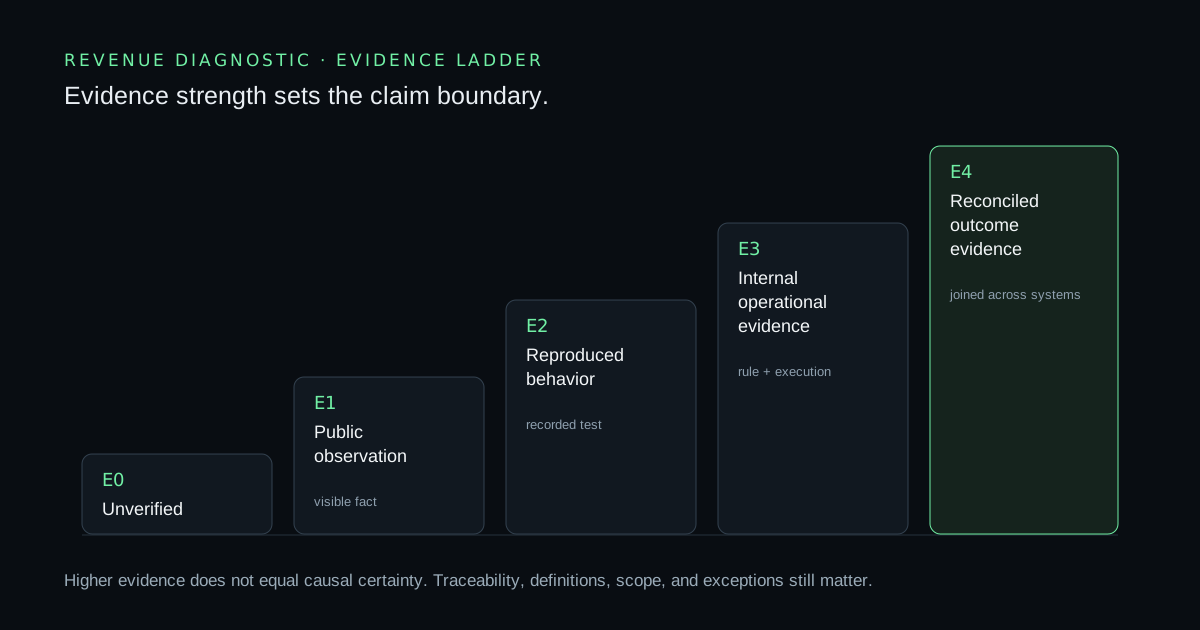
The Revenue Diagnostic Evidence Ladder
The ladder states how much an item can support. It is a claim-control framework, not a claim that every organization needs the same tools.
| Level | Name | Can support | Example | Cannot support alone |
|---|---|---|---|---|
| E0 | Unverified statement | A question worth testing | Stakeholder recollection, concern, or tool inventory | A finding |
| E1 | Public observation | A bounded visible fact | Status, path, field, confirmation, or metadata | Internal execution, frequency, or impact |
| E2 | Reproduced behavior | A repeatable result under recorded conditions | Permissioned synthetic submission or controlled path test | Population-wide rate or financial impact |
| E3 | Internal operational evidence | A configured or executed internal state | Rule, workflow run, CRM history, task, or delivery record | Downstream impact without reconciliation |
| E4 | Reconciled outcome evidence | A joined result across systems for a defined scope | Source-to-CRM-to-outcome reconciliation with exceptions | Causal certainty beyond the design and data |
Evidence quality also depends on traceability: where it came from, when it was observed, under what conditions, and which statement it supports. A higher level is not a license to ignore definitions, scope, sampling, or exceptions.
Observation, hypothesis, and verified finding are different records
What was directly seen
A bounded statement of observable behavior. Good: “At 14:10 UTC the public form displayed a success state with no next-step expectation.” Weak: “The lead system is broken.”
What may explain it
A plausible explanation or consequence that the evidence does not yet prove. It should predict evidence and remain falsifiable.
What the joined evidence establishes
A statement traced to sufficient internal or reconciled evidence for a defined scope, with alternatives and occurrence limits retained.
Every item should have one current status: OBSERVATION, HYPOTHESIS, VERIFIED_FINDING, DISPROVED, or INSUFFICIENT_EVIDENCE.
Confidence grades
Confidence describes confidence in the stated finding, not its apparent severity. Downgrade it when evidence is stale, sampled without a rule, missing a timezone or definition, affected by permissions, or obtained through a path different from normal operation.
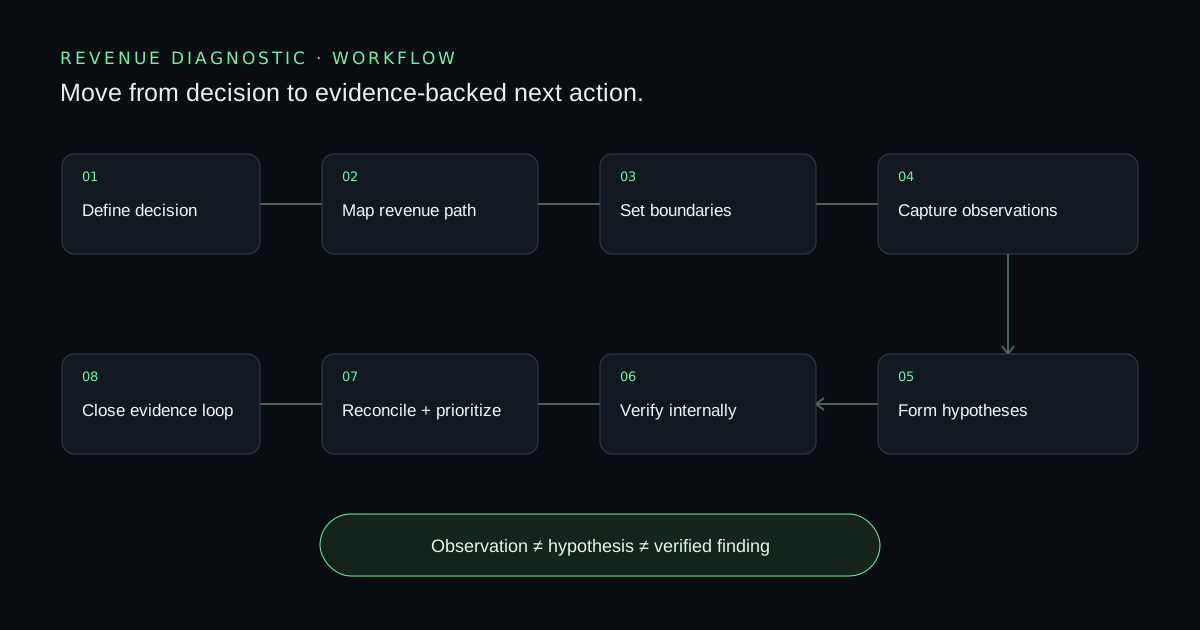
Eight stages from decision to verified next action
- 01
Define the decision
State the exact decision the diagnostic must support. A useful scope is “decide whether to repair lead routing,” not “review everything.”
- 02
Draw the revenue path
Map sources, destinations, capture events, identities, owners, states, follow-up, outcomes, and reporting. Mark every handoff.
- 03
Set boundaries and permissions
Separate public, synthetic, internal, restricted, and excluded evidence. Record production-change and privacy boundaries before testing.
- 04
Capture public observations
Record the URL or surface, UTC time, device where relevant, action, observed result, and sanitized evidence reference.
- 05
Form falsifiable hypotheses
List plausible explanations and the evidence each would predict. Do not choose the most commercially dramatic explanation.
- 06
Verify internally
Trace approved test records and samples across configuration, execution, ownership, delivery, state, and exception evidence.
- 07
Reconcile and prioritize
Resolve definitions and counts, grade evidence and confidence, then prioritize containment, detection, repair, or a smaller verification step.
- 08
Close the evidence loop
Define the owner, resolution test, rollback, monitoring state, unresolved evidence, and the next decision.
Finding record format
A usable finding record contains: identifier; current state; surface and transition; bounded statement; evidence references; evidence level; confidence; scope and sample rule; alternative explanations; what is not established; priority; accountable owner; next verification or repair; resolution test; and monitoring or rollback state.
The deliverable should be a traceable decision package—not a slide of generic opportunities. A buyer should expect a revenue-path map, evidence register, finding records, priority decisions, unresolved questions, module ownership, and the smallest safe next step for every material item.
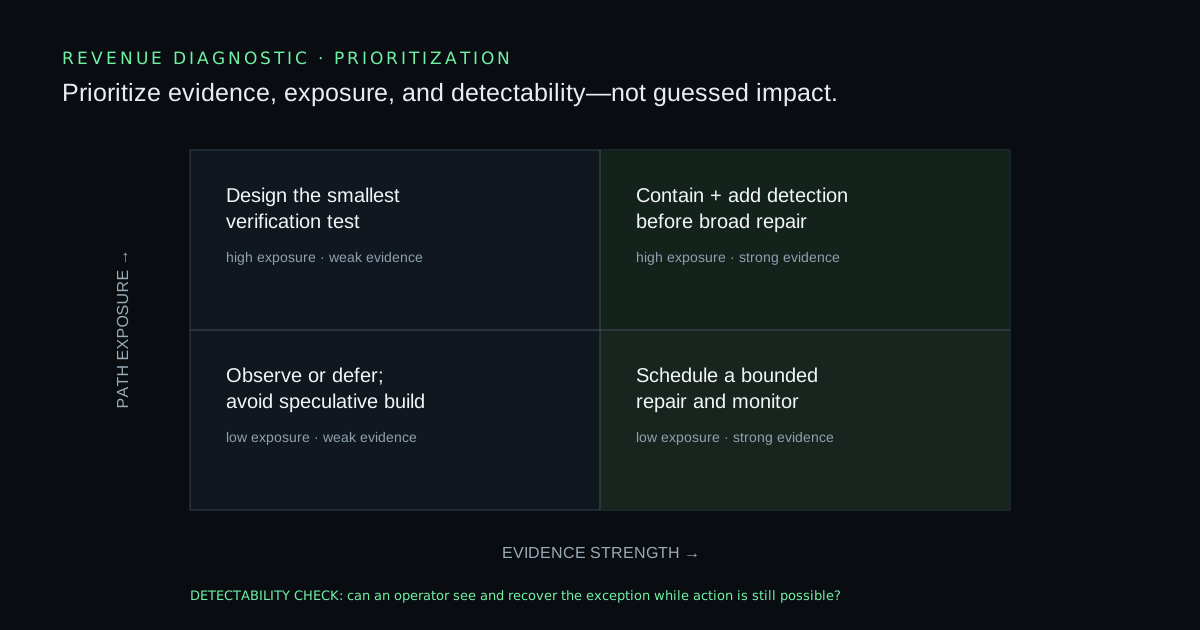
Prioritize the failure state and evidence gap separately
Evaluate path criticality, exposure, evidence strength, detectability, dependency, reversibility, and verification cost. Then use this order:
- Contain verified states that prevent capture, ownership, lawful communication, or reliable recovery.
- Add detection where material failures can occur silently.
- Repair high-exposure, high-confidence handoffs.
- Close evidence gaps that block several downstream decisions.
- Test medium-confidence hypotheses with reversible changes.
- Defer low-confidence optimization until the path can be observed.
Labels such as CRITICAL, HIGH, MEDIUM, LOW, and INFORMATIONAL describe diagnostic urgency. They are not forecasts of revenue impact.
Decision matrix
| Evidence state | Exposure / detectability | Recommended decision | Do not infer |
|---|---|---|---|
| Verified failure | High / low detection | Contain, add an exception control, then repair. | Monetary impact without reconciled outcomes. |
| Verified failure | Low / high detection | Schedule a bounded repair and monitor. | That low exposure means no impact. |
| Reproduced public behavior | Unknown / low detection | Open the smallest internal verification. | That the internal workflow failed. |
| Conflicting evidence | Any | Reconcile identity, definitions, and timestamps. | That either system is automatically authoritative. |
| Hypothesis only | Any | Design a falsification test. | That urgency turns a hypothesis into a finding. |
| No observable failure | Low detection | Improve observability before declaring health. | That absence of evidence is evidence of absence. |
Map verified findings to the module that owns the transition
Mapping does not commit a build scope. Scope follows verification. One finding may affect several modules, but the initial repair should be owned by the module that controls the broken transition, with explicit tests for downstream effects.
| Diagnostic surface | Likely module family | Typical handoff |
|---|---|---|
| Acquisition | Acquisition and source capture | Source taxonomy, destination routing, and identifier preservation |
| Conversion path | Lead capture and conversion paths | Pages, forms, consent, validation, confirmation, and recovery |
| Response and routing | CRM and pipeline automation; speed-to-lead | Normalization, assignment, fallback, timers, and alerts |
| Booking | Booking and conversion paths | Calendar routing, event state, reminders, rescheduling, and recovery |
| CRM | Revenue infrastructure; CRM and pipeline automation | Identity, lifecycle, ownership, pipeline rules, and data quality |
| Follow-up | Follow-up automation | Eligibility, sequences, tasks, stop conditions, and escalation |
| Attribution | Tracking and attribution | Event model, source persistence, identity joins, and reconciliation |
| Reactivation | Reactivation systems | Eligibility, suppression, segmentation, and outcome handling |
| Reporting and observability | Reporting and observability | Exception queues, reconciliations, definitions, and operating views |
Northstar Equipment Services: a method demonstration
Fictional example: Northstar Equipment Services and every count below are invented solely to demonstrate the method. They are not an OmniLabs client, case study, benchmark, or claim about typical performance.
A reviewer observes that a permissioned synthetic form submission displays “Submitted” without an owner, timing, or recovery instruction. That observation does not establish what happened after the public success state.
Step 1 — public observation
- Status:
OBSERVATION - Evidence: E2, because the behavior was reproduced under recorded conditions.
- Confidence: C2.
- Not established: CRM creation, notification, assignment, response, occurrence frequency, or commercial impact.
Step 2 — competing hypotheses
- The confirmation copy may be the only issue and processing may be healthy.
- The form may create a record but fail to assign it.
- Identity rules may update an existing record.
- A notification may deliver while CRM ownership remains blank.
Step 3 — approved internal verification
For the fictional review set, the team joins form events, CRM history, assignment history, and first-activity timestamps. Forty-two form events reconcile to 42 created or updated CRM records. Thirty-nine receive active owners. Thirty-eight show a first activity inside the defined review window.
The three unassigned records share a territory value with no matching rule and no fallback queue. The remaining assigned record has no first activity because its owner is unavailable and no reassignment control exists. These invented counts demonstrate reconciliation mechanics only.
Step 4 — bounded findings
Three records were unassigned because no territory rule matched and no fallback existed. Evidence E4; confidence C4. Add a monitored fallback and test matched and unmatched paths. Do not infer revenue loss or frequency outside the set.
One assigned record had no first activity and no absence-aware reassignment. Evidence E3; confidence C3. Define acceptance or reassignment and test it with an approved record.
The public success state gives no response expectation. Evidence E2; confidence C2. Treat the copy decision separately from the routing repair and align it with the real operating expectation.
The visible copy did not prove the routing failure, and the routing failure did not prove financial loss. Internal reconciliation verified a specific rule gap and supplied a safe repair test.
A diagnostic is complete when the evidence can survive review
Scope and governance
- The decision to be supported is written.
- In-scope systems, routes, identities, regions, and time windows are listed.
- Public, synthetic, internal, restricted, and excluded evidence are distinguished.
- Credentials, personal data, and customer records have an approved handling path.
- Prohibited actions and production-change boundaries are recorded.
Revenue-path map
- Every important source has an intended destination.
- Every conversion event has a defined success, failure, and recovery state.
- Every captured intent signal has an ownership rule and fallback.
- Response clocks and operating hours are defined.
- Each transition names input, rule, output, owner, timestamp, and exception path.
Evidence
- Every claim has a source and observation time.
- Public signals are not presented as proof of internal execution.
- Internal configuration is checked against execution history.
- Counts use shared definitions, timezones, and sampling rules.
- Conflicting evidence is retained and reconciled explicitly.
Findings
- Every item is labelled observation, hypothesis, verified finding, disproved, or insufficient evidence.
- Every item has an evidence level and confidence grade.
- Alternative explanations remain visible where evidence is incomplete.
- Priority does not imply guessed revenue impact.
- The smallest verification or repair step and resolution test are named.
Closeout
- Sensitive evidence is sanitized or access-controlled.
- Open hypotheses are separated from verified findings.
- No unsupported performance, ranking, revenue, or conversion claim remains.
- The next build scope follows the evidence rather than preceding it.
What this method does not promise
- A diagnostic is scoped. It cannot establish the health of paths, periods, or systems it did not inspect.
- A synthetic test is a test case. It does not automatically represent every visitor, record, owner, or rule combination.
- System records inherit system definitions. A field or dashboard is not authoritative until its transformations are understood.
- Reconciliation is not causality. Joining source and outcome improves reconstruction; it does not isolate why an outcome occurred.
- Public absence is ambiguous. A compensating control may be internal, and a healthy public state may still fail downstream.
- Priorities change with evidence. A concerning hypothesis can be disproved; a modest observation can become important after verification.
Source and evidence policy
- Prefer direct platform documentation, provider reports, system logs, and reproducible first-party observations for behavior claims.
- Use secondary sources for context, not as evidence about the inspected organization.
- Record retrieval dates, observation times, access class, scope, sampling, and provider limitations.
- Keep public and internal evidence separate; publish no credentials, personal data, customer records, private report locators, or account identifiers.
- Preserve zero-data, unavailable, disproved, and conflicting states as such.
- Correct or annotate findings when later evidence changes the conclusion.
Apply the method before committing to a build.
A Diagnostic Review works through visible findings, names the internal evidence that would close each one, and decides whether deeper verification or a scoped Revenue OS implementation is warranted. A completed scan is not required. Public signals are not treated as proof of internal operations.